CS 151 Spring 2025 Syllabus Labs/Projects
Project 11: Video game
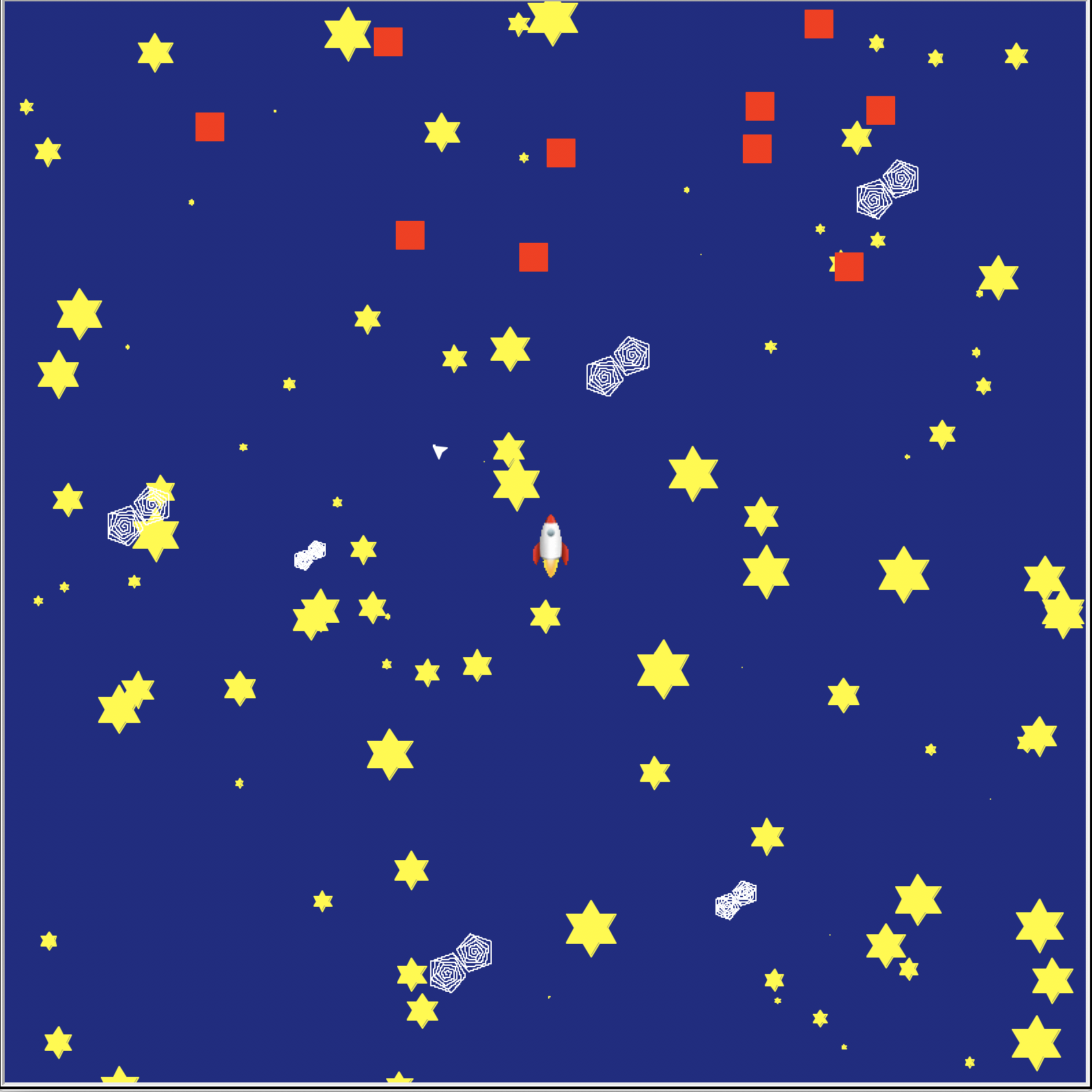
This is your last project in CS151! It will be more open ended than the previous projects. The goal is to create a video game using turtle. Be creative and have fun!
1. Create a video game
Implement a game other than Asteroids, using inheriting from the provided Abstract Class Game. The more detail, gameplay elements, and/or complexity the more extension credit. As usual, code organization and design play a big role and you should follow the standard best practices.
Your game should inherit from the Abstract Class Game. From a grading perspective, I should not see lots of duplicate code in Game and your other game class. Make use of inheritance and extend the basic game mechanics if it makes sense!
You can implement a standard game, a different game, or your own game.
Suggested Standard Games
You can choose to implement a standard game for up to 27/30 for the base game. To receive 30/30, you can add extensions like additional levels or the ability to replay your game.
Suggested Advanced Games
You can choose to implement an advanced game for up to 28.5/30 for the base game. To receive 30/30, you can add extensions like additional levels or the ability to replay your game.
Other games
You can choose to implement a game that is not listed above. Please meet with Professor Wolfe during their office hours to have your game approved. They will determine if it is a "standard" or "advanced" game.
Design your own game
You can choose to design your own game. Please meet with Professor Wolfe during their office hours to have your game approved. They will determine if it is a "standard" or "advanced" game.
New Game Guidelines
- Keep it simple!
- Your game should have a start screen, end screen and interactivity.
- Before you start coding, design your game. Your design does not need to be "final", but you should at least roughly outline the main game elements before driving in. I suggest breaking things down through top-down design.
- Follow the design pattern from projects where you repeatedly test your game as much as possible. Use top-down design! Do not wait until the very end of your implementation to start testing! That's overwhelming! Always think about places where you can test modular pieces of your implementation before you add many moving parts together, any one of which might have bugs.
- You should use object-oriented design. If you find it useful to create additional parent and child classes, feel free to do so!
Game Demo
Everyone who completes their project "on-time" will be expected to demo their work to the class on Thursday May 9th. The goal is to have fun and give us an opportunity to celebrate your work!
- Your presentation should be limited to 2 minutes or less.
- Your demo should be informal: you should walk us through your game as you play it, explaining what you designed and briefly outlining key design decisions. You do not need to show us any code.
- Please submit your final project by Wednesday May 8th. This will give me time to organize the presentation schedule.
2. Written Report
In addition to submitting your code, you will be expected to include at least the following elements in the report. Your report should be about the same length as a usual project report.
a. Abstract
The usual abstract — summary of what you made and what concepts you used to do it.
b. Design
Describe the game. Explain how the game is played and what the rules are. Include links to relevant resources about the game.
c. Implementation
Describe your implementation — how you organized your code (e.g. key classes, important methods) and made key parts of the game work (e.g. events, how you solved problems to get key elements of your game working).
d. Explanation of Gameplay
In your report, include at least three still images (Required Images 1, 2, and 3) — one image for each phase of your game: start, main, and end. If your game has multiple stages during the main game play or multiple game end screens, include an image for each stage/ending. For each image, explain what is happening in the image and how you implemented that portion of the game.
e. Gameplay testing
Explain how you tested the gameplay in your report, and describe any modifications you made to the program after having someone else try to use it.
This means playing your game! Iteratively refine the controls, rules, difficulty, and artwork. Try to partner with someone and test each other's implementations. Discuss how to improve your programs to make them more responsive or interesting or fun.
No one writes perfect code the first time! If you don't change anything after someone else uses your program, you probably aren't listening to feedback closely enough.
f. Conclusion
The usual section.
g. Sources and collaborators cited
Please provide URLs and sources for any images and artwork you used in your game. This is important and points will be taken off if these citations are missing in your report.
Please provide URLs and sources that you used to learn about your game and design it.
Also cite the usual including students, TAs and faculty you discussed your code with and websites you used as reference.
h. Game Video
Include in your project submission a maximum 90 second screen recording video of you playing and demoing your game. This should include the start screen, game play, and results screen.
Extensions
Between the code that you’ve already written and the report that you write, you’ve already earned up to 26/30 points for this project. If you turn it in by the first deadline that's 27/30 points.
The remaining 3/30 are a chance for you to earn credit for exploring parts of this project and digging deeper to express your creativity! This is entirely optional; 27/30 is an A- and is a perfectly respectable place to stop. Extensions are open-ended and exist to compliment the structured core project. Explore and learn something new that interests you! Concentrating your energy on 2 "deep" extensions that challenge you will earn you more points than many small, "shallow" extensions.
- Use complex visuals, animation and interesting graphics. (+.5-1pt dependent on complexity)
- Organize your code using multiple classes (+.5pts) and inheritance (+1pt), not just GameABC.
- Make your program replayable so the user can return to the start screen from the final screen and replay the main phase. (1pt)
- Add a leader board to your game to track high scores (+1pt). Have the leaderboard persist between plays (+1.5pts).
- Make your program/game have more than one level (1pt). Have infinite levels (+1.5pts).
- Add a two-player mode (1.5pts). may not be applicable to all games
- Add a physics engine to your game. You could simulate the way that gravity (+1pt), momentum (+1.5pts), and/or spring forces and damping (+1.5pts) would influence the motion of objects on your screen may not be applicable to all games.
Congratulations!
Congratulations on your first video game! Thank you for your hard work and creative problem solving this semester. It’s been an honor to work with you, and I hope to see you again in other CS courses in the future. 😃