CS 333 Programming Languages
Project 7
Due: Thursday, April 30 2026, 11:59 pm
Part I: Memory Management in C
Tasks
-
This task is to try and estimate the time cost of memory management in C.
What is the average time per call to allocate a certain amount of memory?
Try timing several hundred/thousand calls to make the estimate, and try the experiment with at least three different memory sizes (small, e.g. 100 ints, medium e.g. 10K ints, large e.g. 1 million ints). Note that the first time malloc is called, there are start-up costs, and it takes extra time. Do not include the first call to malloc in your timing.
You are expected to observe the time it takes to allocate a range of amounts of memory. What are the trends relating the allocation time to the size of thh allocation? Is it more efficient to allocate all the bytes at once, or in smaller chunks? Answer these questions in your report, using at least one graph with your data to back up your explanation.
There are many ways to time code. You can pick the way that works for you best. One is to use the ftime library call, which returns a time stamp you can use to estimate total run time reasonably well. Don't try to use it to time small things. But it works ok to use for stuff that takes at least a quarter-second.
The second way to time code is to use a profiler. On a Mac, you can use Activity Monitor, which you can find in the Instrument. On a linux machine, you can use a tool called gprof. You can use gprof on any of the dwarves (linux machines) in the robotics lab.
Write C code to familiarize yourself with the process of a Mark and Sweep Garbage Collector. In an effort to keep this as short, but informative, as possible, we are going to represent the stack and heap with structs, and write main code that manipulates the stack and heap as if there were calls to malloc and assign. Your job will be to implement a Mark and Sweep algorithm. But first, we need to describe the setup.
- The simulated stack will store Vars. A Var stores a name (char *) and a reference to the heap, which could be NULL, if we are simulating a variable that isn't a pointer.
- The simulated heap will allocate HeapChunks. A HeapChunk stores a list of pointers to other chunks (which could be NULL) along with the number of references to other chunks.
- The Program State stores an array of Var structs (the stack), the number of items on the stack, an array of allocated HeapChunks, and the number of allocated HeapChunks.
- When a HeapChunk is allocated, a reference to it is stored in the allocated heap array in the Program State.
- We can assign a HeapChunk reference to a variable on the Stack by callined an updateStack function.
For example, consider the main code
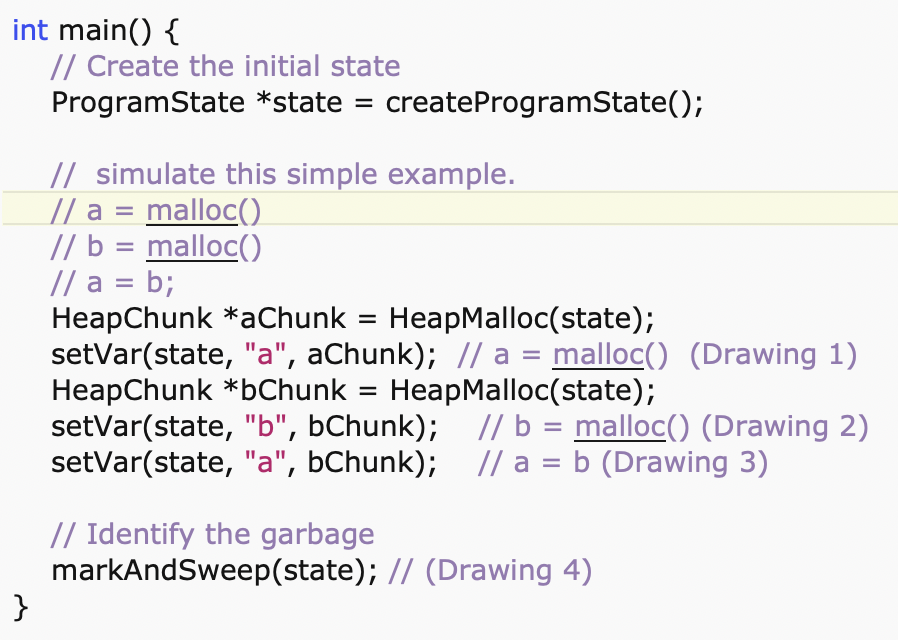
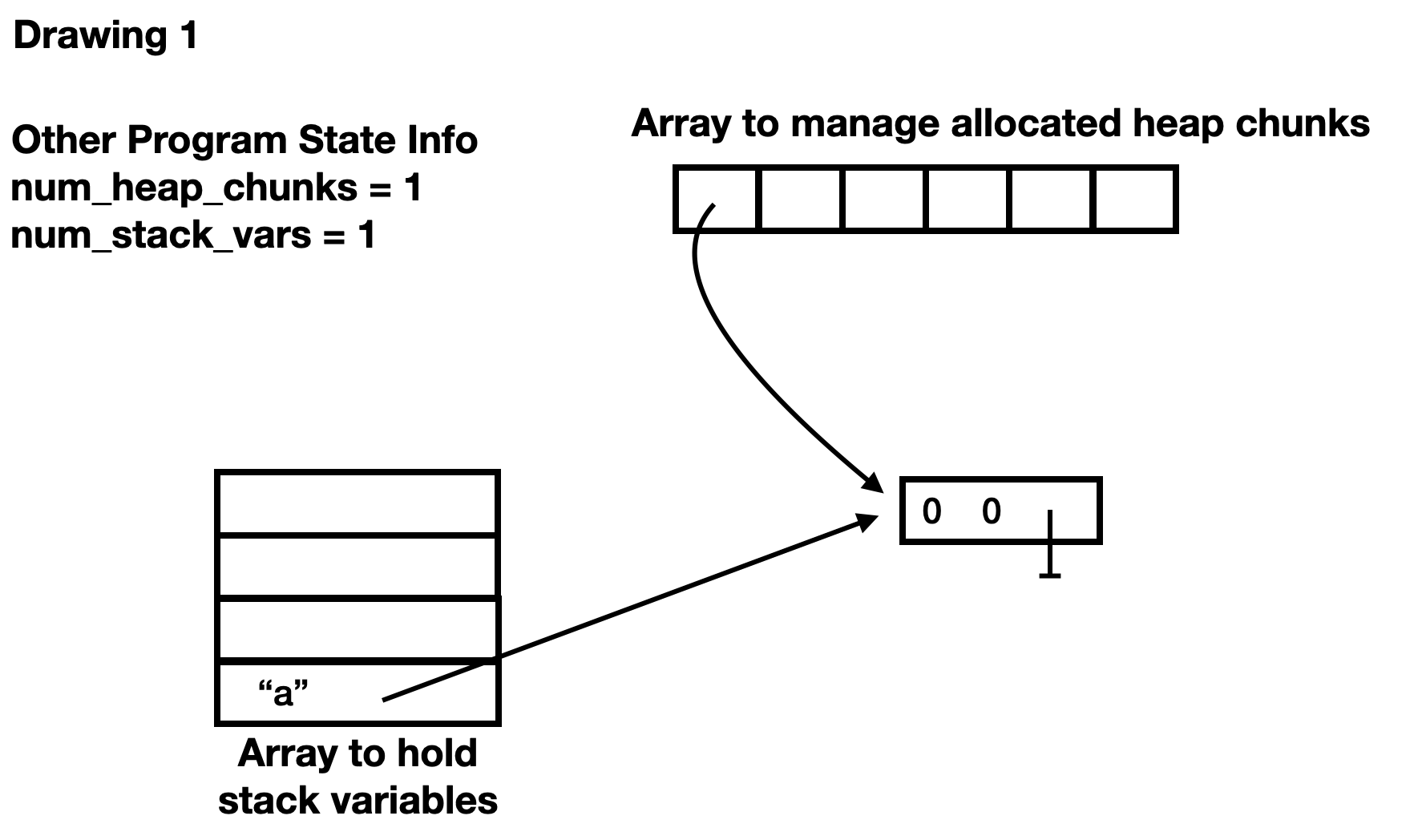
At Drawing 1, we draw the stack with the first entry containing the name of the variable and the reference to a HeapChunk. The heap has just one HeapChunk. The array to manage allocated HeapChunks points to the one HeapChunk. Its entry starts with 0 (it is unmarked), then has a second 0 (there are no other HeapChunks referenced), and ends with a null pointer (there are no other HeapChunks referenced by this one).
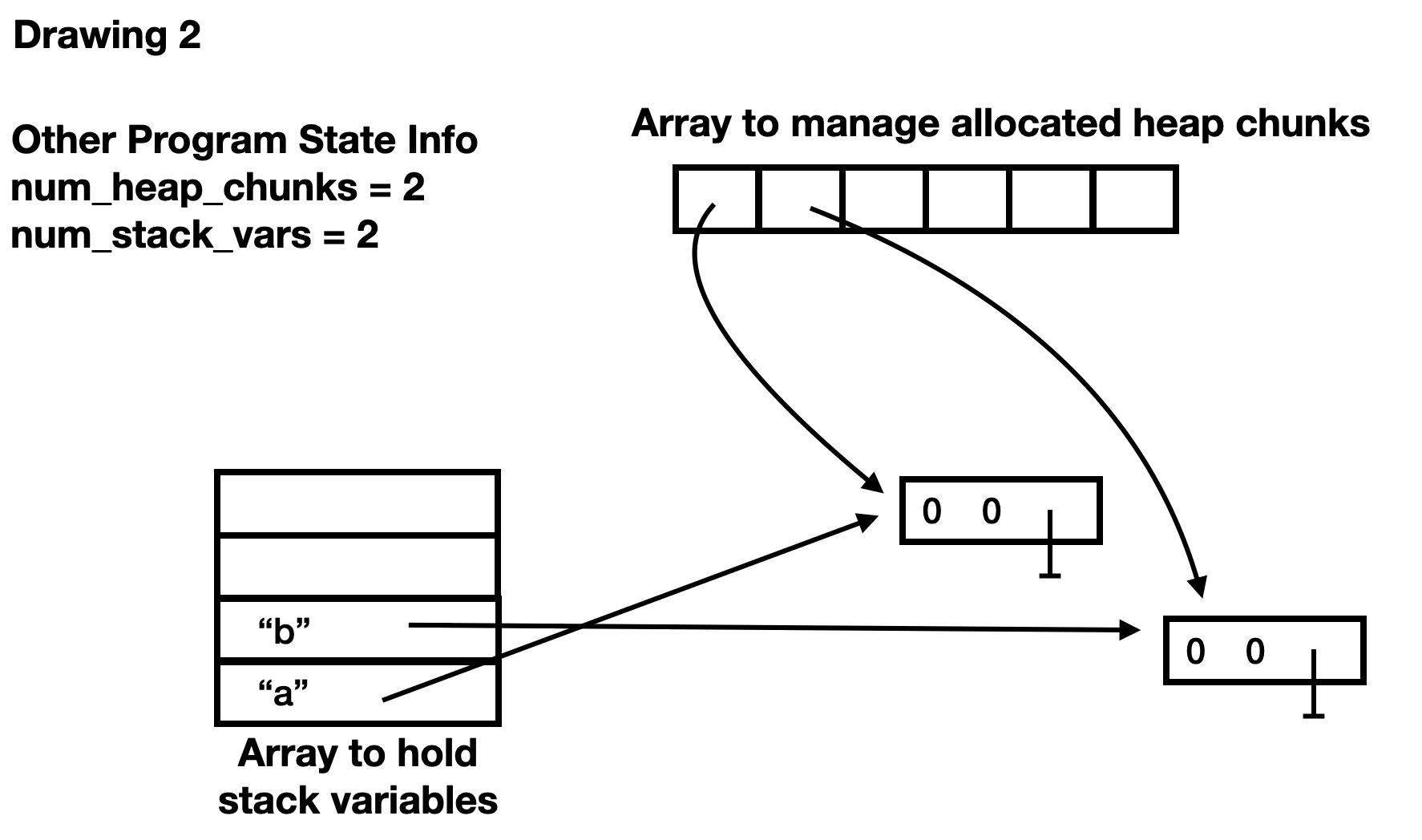
At Drawing 2, we have a second Var on the Stack and a second HeapChunk on the heap.
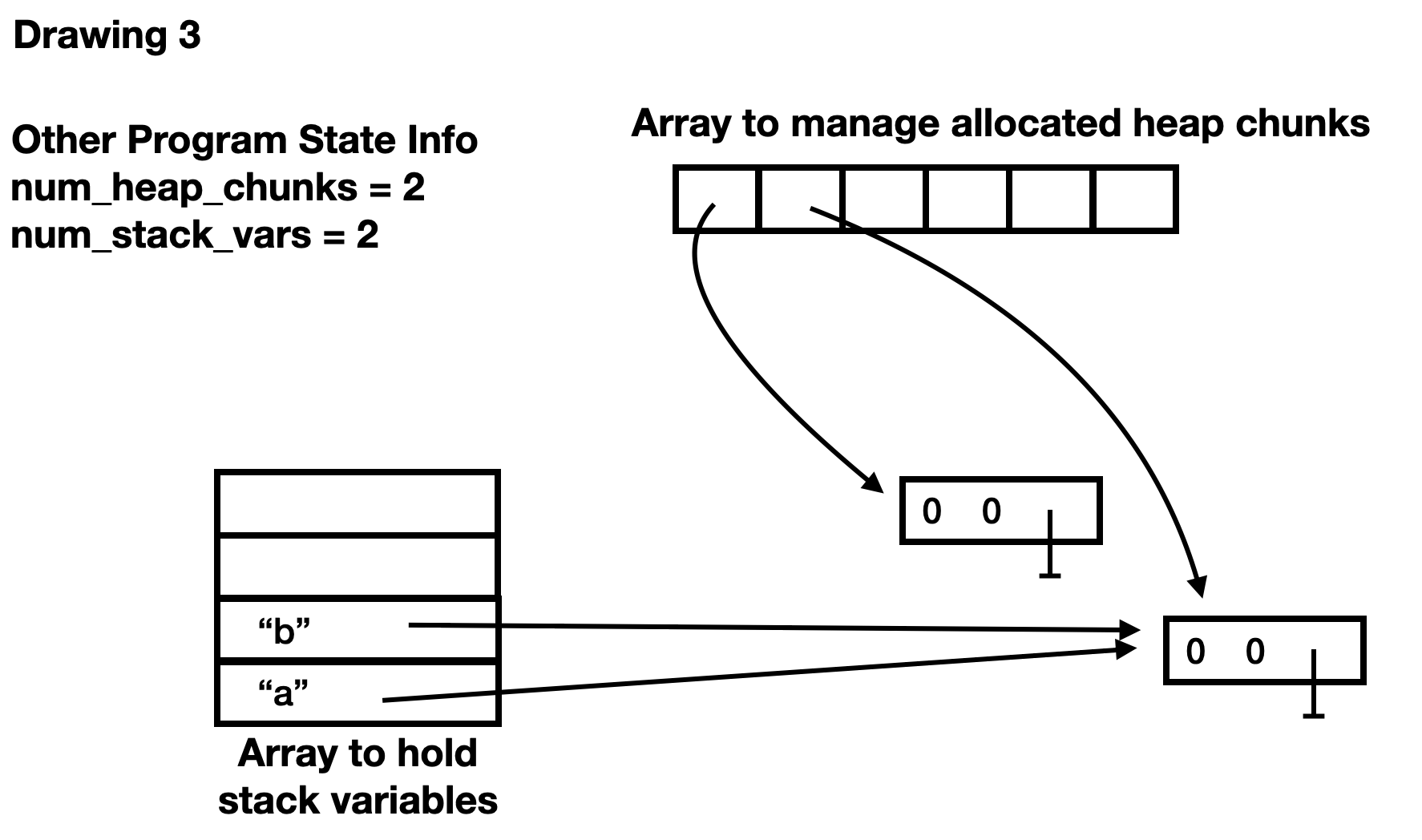
At Drawing 3, we have changed the value of the reference associated with "a"
After the mark phase, we have one HeapChunk marked (the first zero is now a 1). The HeapChunk with a zero for the marked value is garbage and should be cleaned up.
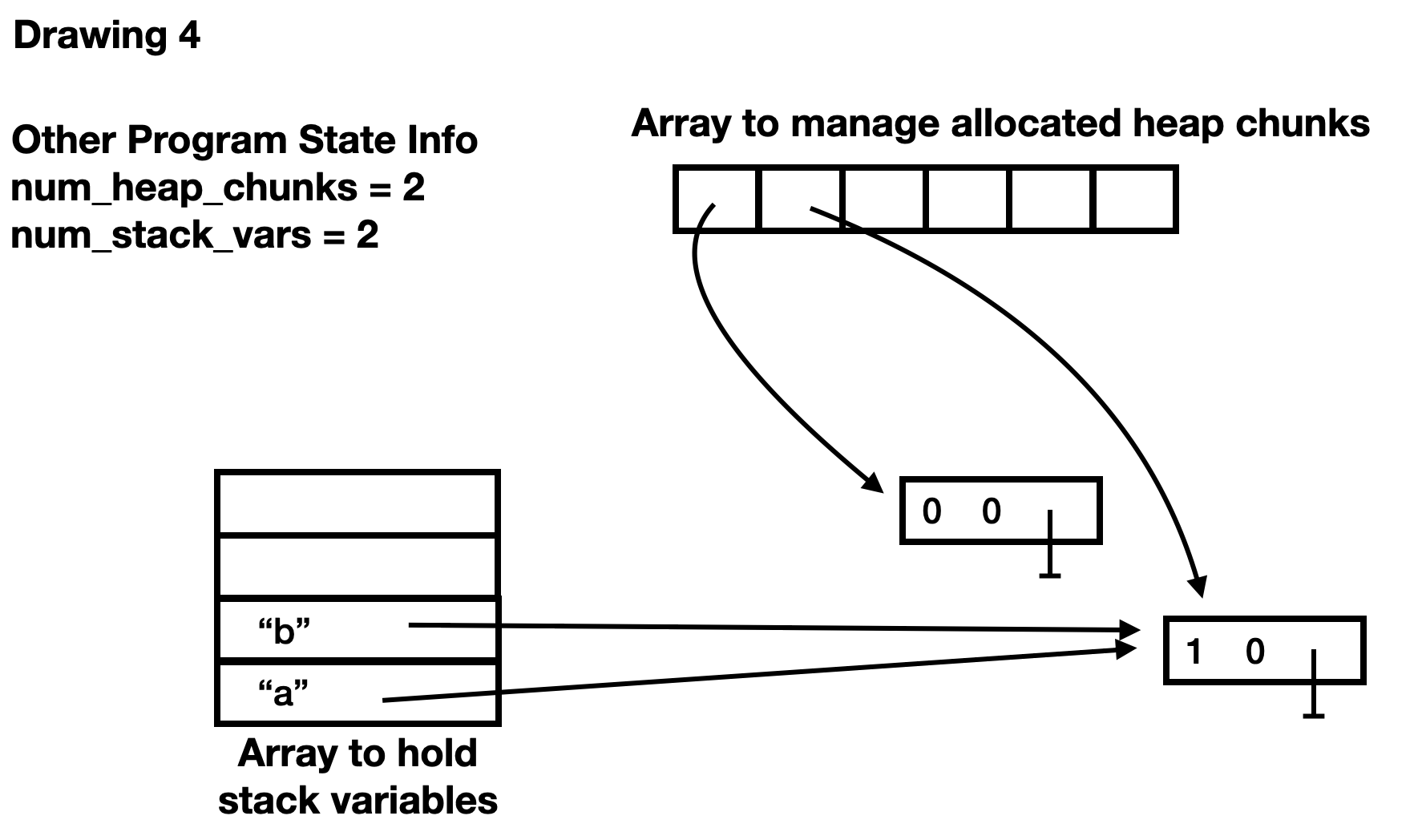
In a more complicated example, we have code that adds references to HeapChunks, creating a circular links. Consider the main code
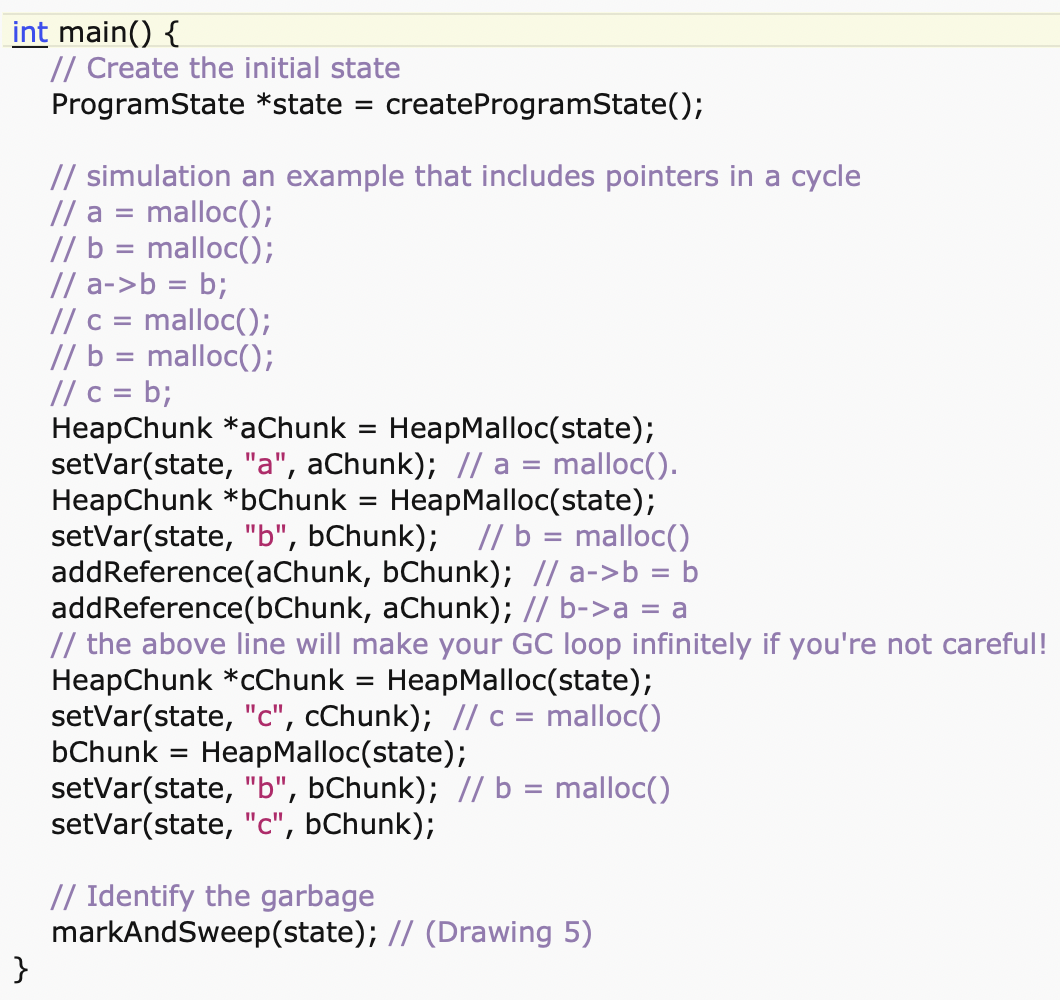
Drawing 5 shows the memory after all the code has been run.
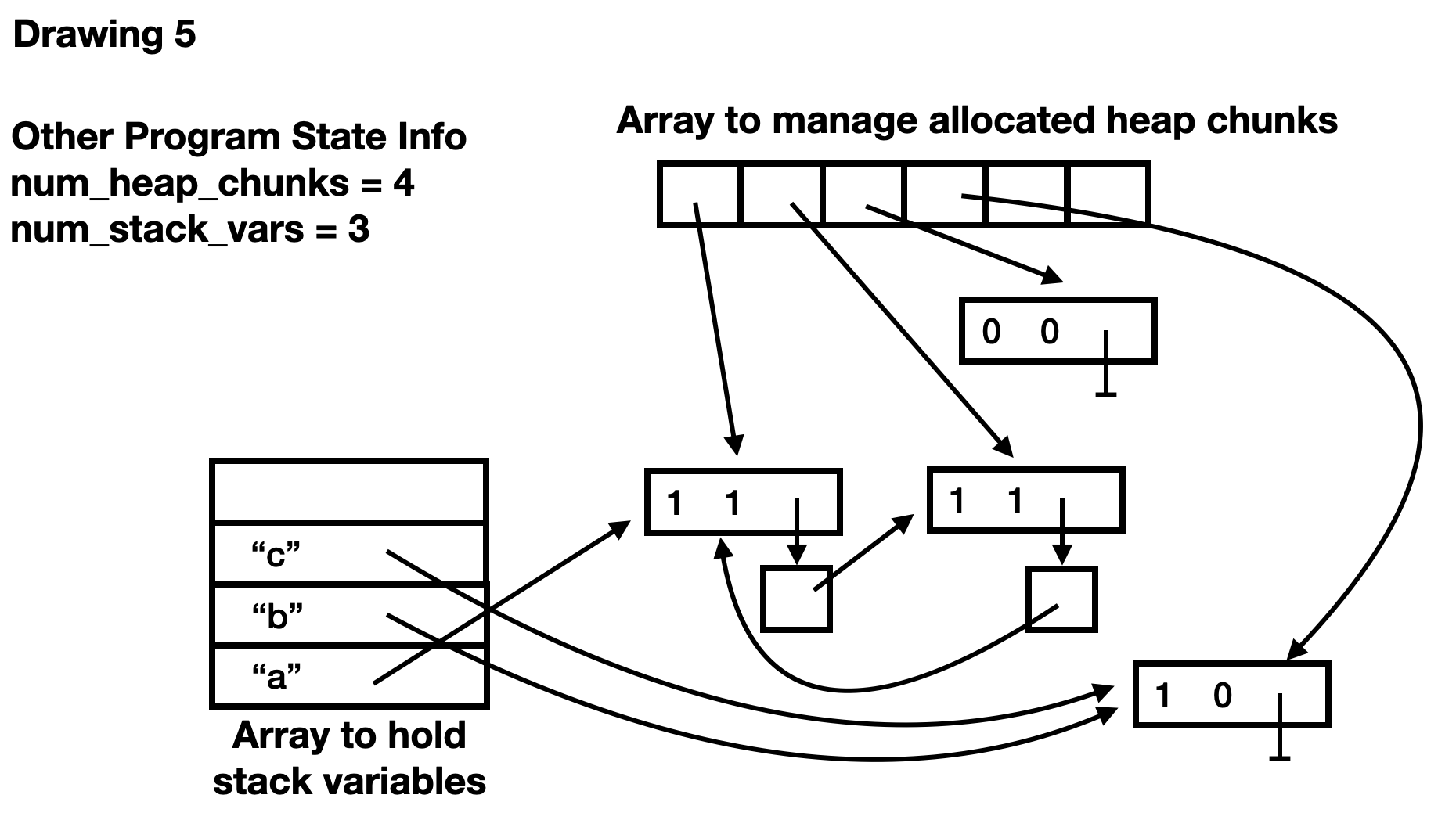
Your first job is to add code to detect_garbage.c to implement the MarkAndSweep function. The instructions are in the comments.
Your next job is to add code to construct a test example of your own, run the code, and draw an image for it, similar to the final image above. The code should simulate at least 3 stack variables, at least 4 allocations on the heap, and should have a reference cycle that can't be reached from the stack (i.e. it should be a good example of why reference counting isn't enough). Add a description of your example (a commented code snippet) and your drawing to your report.
Part II: Memory Management in Selected Language
Tasks
This part is to do some research on memory management in your selected language.
- Do your best to research what memory management algorithms
your languages use. Show your work on the Google Sites.
- If your language has explicit allocation/deallocation, then create some code examples.
- If your language requires allocation, but not deallocation, then create some code examples. Show some side-by-side comparisons of the differences between C and your language.
- If your language pretty much hides memory allocation, show a variety of statements that create memory, and a variety of conditions whereby that memory gets lost (or put back into a free memory pool).
- Undertake an experiment in a language with automatic memory management (or Java, if your language doesn't fit the model), and see if you can identify when a garbage collection sweep takes place. Create and delete lots of memory inside a function and time the function as you call it many times. Look for times when the function call takes significantly more time than average. See if you can write a program that automatically detects garbage collections from the timing information.
Extensions
- Describe memory management for a second selected language.
- For the memory management example, try writing a functionally equivalent example in C, explicitly handling the kinds of information required for the memory management system of your chosen language.
- Look up the code for malloc and free in glibc and explain how they work in your Google Sites report.
- Write a compilable haiku on memory management.
- Use a profiler to test your code. Report on how you used it, include a screenshot of its output, and describe what you learned.
- Explore how to do reference counting properly when writing C code to interface with Python. If you want to try writing code, use the ctypes package in Python to connect to C functions.
Please note that it is your responsibility to explicitly indicate the extensions you have taken. If you take the extension in C, please indicate explicitly in the codes and README file. If you take the extensions in the selected languages, please indicate explicitly in your Google Sites report or source codes and README.
Submission
The submission of this project has two components:
- Create a folder named Project7_<username> Place the required files into it, zip it, and upload it
to the Google Classroom.
Required Files:
- Code: Create a fold for each language, including C and your selected language(s). Place all of your C code and selected language programs to corresponding folders. It should be clear which files correspond to which tasks. All these language folders should be placed into the Project7_<username> folder. Note that the quality of your comments counts toward your grade.
- README: We use markdown files for README files. Markdown files are files with the
.mdfilename extension. Each project should have a README file along with all your source codes. The README file will contain:- Project identifier, your name, and the submission date.
- The URL of your Google Sites report.
- The directory layout for your hand-in folder. You can use the Unix
treecommand to generate this. - Your operating system and C compiler (e.g. use gcc --version).
- For each task, include how to compile your program, how to run your program, known bugs if there is any, and the program output (a screenshot). The screenshot should include the actual output of running the program if the output is no more than 100 lines. Otherwise, give a brief version of the output.
- Text and images reporting on the C part of the project.
- A description of each extension you undertook (for the C part of the project).
You can follow the instructions for the README file from Project 1.
- Google Sites Report: The report of this project should have the following elements.
- Title of the project and your name
- A section for each task of part II. Every section should contain the snapshot of your sample programs, the outputs, and your explanations.
- If you complete extensions in your selected language, please include a section for each extension, providing sample programs, outputs, and explanations.
To check whether you've made your report well organized, please follow the Organization part in the Google Sites section in this writing page. Remember to publish all your changes and include the homepage link of your CS333 Google Sites in the README file.
Please do NOT include: Executable files. On Windows, these have the .exe extension. On Mac and Linux, there is no e xtension. We have found that graders often have difficulty downloading submissions if they contain executable files.
© 2026 Ying Li. Page last modified: .