Hannen E. Wolfe
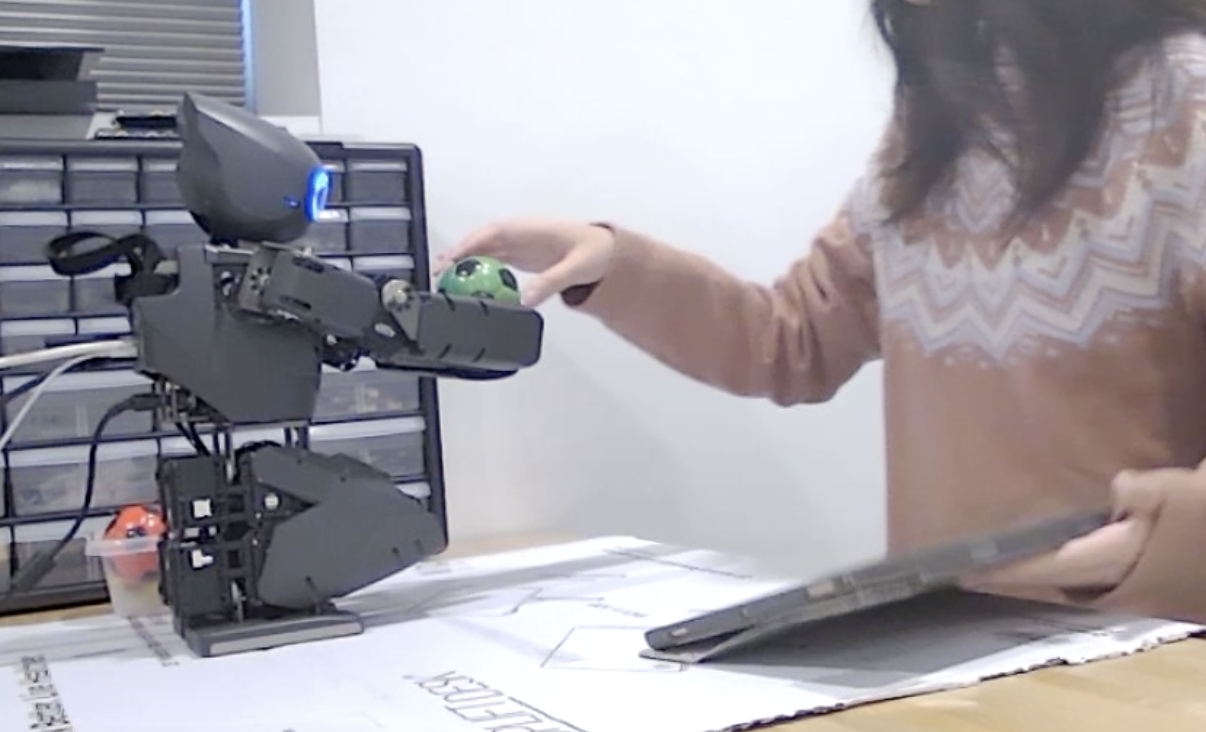
Non-Linguistic Utterances (NLUs) are essential parts of emotive exchanges, not only in human-human interactions but also in the context of human-robot interactions. This research aims to deepen our understanding of emotive sounds for the domain of human-robot exchanges. We investigated the connections between certain audio qualities and the perception of emotional arousal and pleasure, designing a novel mapping of musical and prosodic audio parameters to a dimensional model of emotion which allows a robot to express a range of emotions. This research contributes valuable insights into how to design NLUs which can enhance the emotional depth of human-robot interactions, with potential applications across various domains.
 Publications:
H. Wolfe, Y. Su, & J. Wang. "Dimensional design of emotive sounds for robots." Proceedings of the 2024 ACM/IEEE International Conference on Human-Robot Interaction (HRI '24). Boulder, CO, USA, 2024.
Wolfe, H., Peljhan, M., & Visell, Y. "Singing robots: How embodiment affects emotional responses to non-linguistic utterances." IEEE Transactions on Affective Computing 11.2 (2017): 284-295.
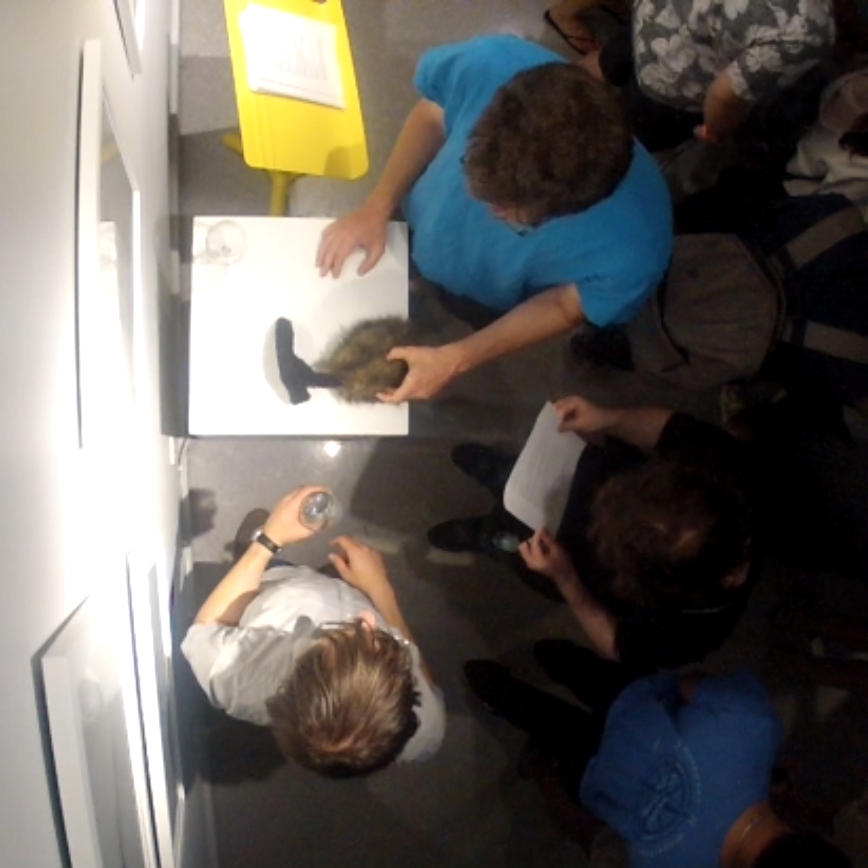
Exhibition spaces are spaces to provoke visitors with new experiences and are a potential space for exploration and conduct human subject research. This research explores the data collected about how a robot was touched at an exhibition. The robot experiences its world through pressure sensors, responds to touch through haptic feedback and sound, and records the sensors' data for analysis. In this exhibition, the pressure sensor readings were used to control a haptic purring sensation and a sonic "scream." Visitors' interactions with the robot and each other emphasized the difference in emotional expression haptically and sonically and the conflict it can create between a participant and an observer when they do not align. The exhibition space gives visitors the opportunity to interact with a robot in a non-laboratory setting, and for researchers to collect data from their interactions. Based on the collected data, a taxonomy of gestures is proposed for a tactile interactive robot.
 Publications:
H. Wolfe, A. Dimitrov, & J. Kuchera-Morin. “Exhibition Spaces for Human-Robot Interaction Tactile Data Collection” In Proceedings of the International Symposium for Electronic Art (ISEA 2024). Brisbane, Australia, 2024.
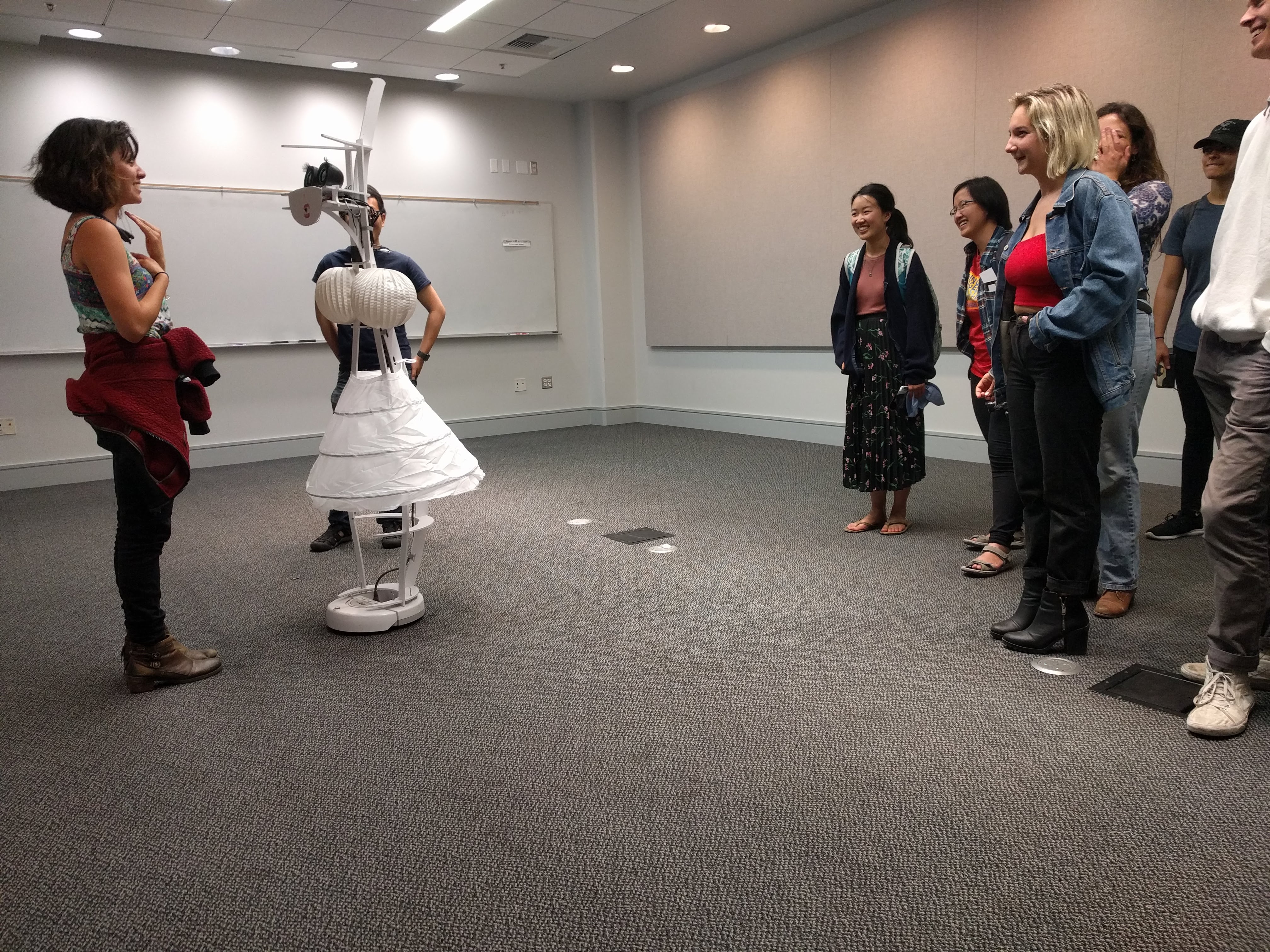
"Interrogative Human-Robot Interaction" applies components of intersectional human computer interaction, critical computing, and interrogative design to social robotics. Our theatrical robotic performance, “Come Hither to Me!” (2018-20), exemplifies the proposed design approach for Interrogative HRI. We published the book chapter, "Designing Interrogative Robot Theater: A Robot Who Won’t Take No for an Answer" which reviews the details of the embodiment design, embodied interaction design, character design, dialogue design, staging, and dramaturgy used in the process of developing our theatrical robotic performance. It discusses the design and implementation of our proposed approach, "Interrogative HRI," for critical, creative, and performative applications. To disseminate this performance we created a video documenting the work. This video was presented as part of the Video Track of HRI 2022 and at the Performance Workshop at IMX 2022.
 Publications:
* denotes equal contribution
S. Sajadieh* & H. Wolfe*. "Designing Interrogative Robot Theater: A Robot Who Won’t Take No for an Answer." Creating Digitally: Shifting Boundaries: Arts and Technologies—Contemporary Applications and Concepts. Cham: Springer International Publishing, 2023. 183-211.
H. Wolfe* & S. Sajadieh*. "A robo-pickup artist breaking gender norms." In Proceedings of the 2022 ACM/IEEE International Conference on Human-Robot Interaction (HRI '22). IEEE Press, 1210–1211. 2022.